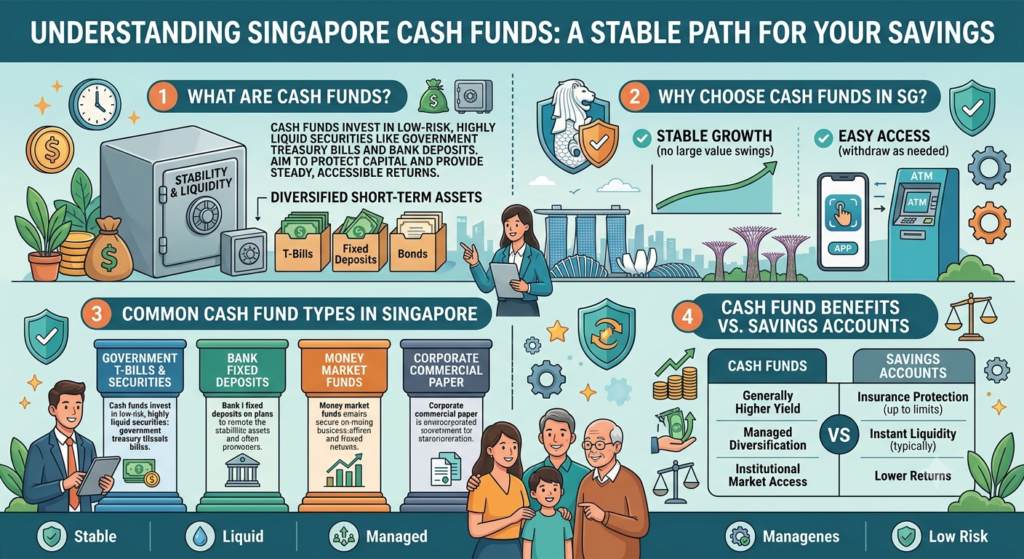
Introduction: What are Cash Funds of Singapore?
Cash Funds of Singapore are investment vehicles designed to offer a low-risk way to manage liquidity by investing in short-term, high-quality debt instruments. These funds primarily invest in highly rated money market instruments, such as treasury bills and short-term corporate debt, providing a place for both individuals and businesses to park surplus cash.
For many in Singapore, these funds serve as a “cash management solution,” offering a way to potentially earn higher yields than a standard savings account while maintaining a high level of liquidity. They are highly popular among retail investors looking for an alternative to traditional fixed deposits and among businesses managing daily operational cash flows.
In the Singaporean financial landscape, these funds act as a bridge between low-interest bank accounts and higher-risk equity investments, providing a stable environment for capital preservation.
Types & Key Features: Money Market, Enhanced Cash, & Liquidity Funds
Cash funds in Singapore come in several variations, primarily categorized by their level of risk and liquidity. These include money market funds, enhanced cash funds, and liquidity funds, each serving a specific purpose in a portfolio.
1. Money Market Funds (MMFs)
Money market funds are the most common type of cash fund. They invest in a variety of short-term, low-risk debt securities, including:
- Treasury Bills (T-Bills): Short-term debt issued by the government.
- Certificate of Deposits (CDs): Short-term debt issued by banks.
- Commercial Paper: Short-term unsecured promissory notes issued by high-quality corporations.
Because they focus on very short maturities, the price fluctuations (volatility) are typically minimal, making them a staple for “parking” idle cash.
2. Enhanced Cash Funds
As the name suggests, enhanced cash funds aim to achieve slightly higher returns than pure money market funds. They may extend the duration of the debt instruments slightly or include a slightly wider range of high-quality corporate paper to capture a higher yield. While they offer better potential returns, they may carry a marginally higher risk profile compared to standard MMFs.
3. Liquidity Funds
Liquidity funds are designed specifically for rapid access. They focus on the highest level of safety and the shortest maturity periods to ensure that investors can access their capital with minimal delay. These are often used by institutional investors or businesses that need to keep their capital ready for immediate deployment.
Summary of Key Features
- SGD Denominated: Most cash funds available to local retail investors are denominated in Singapore Dollars (SGD).
- High Liquidity: Most funds allow for redemption on a T+0 to T+3 basis (the time it takes to get your money back).
- Low Volatility: The primary goal is capital preservation, meaning the fund’s value is designed to be stable.
- Diversification: A single fund gives you exposure to many different high-quality issuers, reducing the risk of a single default.
Regulation & Safety: MAS Oversight and Risk Profile
Cash funds in Singapore are regulated by the Monetary Authority of Singapore (MAS) to ensure transparency and investor protection. While they are overseen by MAS, it is critical to understand that they are not bank deposits and do not carry the same level of insurance.
The Role of MAS
The Monetary Authority of Singapore (MAS) oversees the licensing of fund managers and the conduct of fund management activities. This regulation ensures that:
- Fund managers must meet strict capital and professional requirements.
- Funds must provide clear, accurate prospectuses and disclosure documents.
- Investment activities must adhere to standardized risk management practices.
Risk Profile & Safety
While cash funds are considered “low-risk,” they are not risk-free. Unlike bank savings accounts, which are protected by the Singapore Deposit Insurance Corporation (SDIC) up to a certain limit, cash funds are investment products.
Key Risks include:
- Interest Rate Risk: If interest rates rise sharply, the value of existing fixed-income securities held by the fund may decrease.
- Credit/Default Risk: Although unlikely with high-quality instruments, there is always a theoretical risk that a corporate issuer fails to pay back its debt.
- Liquidity Risk: In extreme market conditions, it could take longer than usual to sell the underlying assets to meet redemption requests.
Benefits vs Alternatives: Compared to Savings, Fixed Deposits, and SSBs
Cash funds offer a middle ground between the security of a bank account and the higher returns of long-term investments. When choosing where to park your SGD, it is important to compare them against other common Singaporean financial products.
| Feature | Cash Funds (MMF) | Savings Account | Fixed Deposit | Singapore Savings Bonds (SSB) |
|---|---|---|---|---|
| Returns | Variable (Market-linked) | Low (Fixed/Tiered) | Fixed (Contractual) | Variable/Step-up |
| Risk | Low (Market-linked) | Extremely Low (SDIC) | Extremely Low (SDIC) | Extremely Low (SGS) |
| Liquidity | High (T+0 to T+3) | Immediate | Low (Penalty for early exit) | High (Monthly redemption) |
| Flexibility | High | High | Low | High |
| Capital Guarantee | No | Yes (up to SDIC limit) | Yes (up to SDIC limit) | Yes (by SG Government) |
Comparison Summary
- Vs. Savings Accounts: Cash funds often offer higher yields than standard bank savings accounts, especially in a rising interest rate environment.
- Vs. Fixed Deposits: Fixed deposits lock your money away for a set period. Cash funds offer much higher flexibility, allowing you to withdraw funds much faster.
- Vs. Singapore Savings Bonds (SSB): SSBs are government-backed and very safe, but cash funds can sometimes offer more frequent liquidity and different interest rate sensitivities.
Eligibility & Access: SGD Denomination and Withdrawal Speed
Most cash funds in Singapore are SGD-denominated and highly accessible through various digital platforms. They are designed for ease of use in the local financial ecosystem.
Accessing Funds
You can typically invest in Singapore cash funds through:
- Robo-advisors: Many digital wealth managers offer “Cash Management” portfolios that consist mostly of money market funds.
- Online Banking/Brokerage Platforms: Major local and international banks allow direct investment into MMFs.
- Full-service Wealth Managers: For more complex or larger-scale liquidity needs.
Denomination and Minimum Amounts
Most retail cash funds are SGD-denominated, meaning you invest and receive returns in Singapore Dollars, avoiding currency exchange risk. Many digital platforms have lowered the barrier to entry, allowing users to start investing with as little as $1 to $10.
Withdrawal Speed (Liquidity)
Liquidity is a primary feature of these funds. While not always “instant” like a bank transfer, most funds follow a standardized redemption cycle:
- T+0 to T+1: Very fast, often available on the same or next business day.
- T+2 to T+3: Standard for most diversified funds.
Note: Always check the specific fund’s prospectus for its “redemption period” to avoid surprises.*
Costs & Returns: Typical Fees and Yield Expectations
The returns on cash funds are not guaranteed and depend entirely on prevailing market interest rates. Unlike a fixed deposit, the yield you receive can fluctuate month to month.
Typical Yield Expectations
In the current economic climate, cash fund yields often track the interest rates set by central banks. If interest rates in Singapore are rising, the yields on cash funds generally follow. While they cannot “guarantee” a profit, they are designed to outperform low-interest bank accounts during periods of stable or rising rates.
Fees & Charges
When investing in cash funds, be mindful of the various costs involved:
- Management Fee: Charged by the fund manager to cover operational costs. This is usually deducted from the fund’s Net Asset Value (NAV).
- Trustee/Custodian Fees: Paid to the entities that hold and protect the fund’s assets.
- Platform/Brokerage Fees: If using a third-party app or robo-advisor, they may charge a small percentage or a flat fee for access.
Tip: Always check the “Expense Ratio” when reviewing a fund’s prospectus to understand exactly how much is being deducted from your potential returns.
Who Are They Suitable For?
Cash funds are versatile tools that can serve different segments of the Singaporean population.
1. Retail Investors (Personal Finance)
- Emergency Funds: Many use cash funds as a more productive alternative to a standard savings account for their “rainy day” fund.
- Parking Idle Cash: Instead of letting money sit in a zero-interest account while waiting for a stock purchase or a property downpayment, investors use cash funds.
2. Businesses (Corporate Finance)
- Operational Liquidity: Companies use cash funds to manage the gap between accounts receivable and accounts payable, ensuring they earn interest on their working capital without sacrificing access to it.
- Treasury Management: Large firms use these to manage large cash reserves in a low-risk manner.
3. Conservative Investors
- Those with a low risk tolerance who want to participate in interest rate movements without the high volatility of the stock market.
Important Disclaimers
Disclaimer: This article is for general educational and informational purposes only and does not constitute financial, legal, or investment advice.
All investments involve risk, including the potential loss of principal. The performance of any fund is not guaranteed, and past performance is not indicative of future results. Before making any investment decision, you should:
- Consult a licensed financial advisor to discuss your specific financial situation and risk profile.
- Read the full prospectus and Product Highlight Sheet (PHS) for any fund you are considering.
- Understand the specific risks associated with the fund’s underlying assets.
The author and the platform are not responsible for any financial losses incurred as a result of acting on information provided in this article.
Frequently Asked Questions
What are Cash Funds of Singapore?
They are low-risk investment vehicles that pool money to buy short-term, high-quality debt instruments like Treasury Bills and commercial paper, primarily in SGD.
How do they differ from savings accounts or fixed deposits?
Savings accounts and fixed deposits are bank deposits often insured by the SDIC. Cash funds are investment products that track market interest rates; they offer higher potential returns and better liquidity than fixed deposits, but they do not carry SDIC insurance.
Who regulates cash funds in Singapore?
They are regulated by the Monetary Authority of Singapore (MAS), which oversees fund managers and ensures industry standards for transparency and conduct.
What are the risks and typical returns?
Risks include interest rate risk and credit risk. Returns are not guaranteed and fluctuate based on market interest rates; they generally track the yield of the underlying short-term debt instruments.
Can I access my money quickly?
Yes, most cash funds are highly liquid, with redemption periods typically ranging from T+0 to T+3 business days.
Are they SGD-denominated?
Most cash funds available to the Singapore retail market are SGD-denominated, allowing investors to avoid currency conversion costs and volatility.
How do I invest and what are the fees?
You can invest via robo-advisors, online banking, or brokerage platforms. Common fees include management fees, trustee fees, and platform-specific service fees.
Are they CPF or SRS eligible?
While some specialized money market instruments might be accessible via certain platforms, most standard retail cash funds are not directly investable through the CPF or SRS schemes. Typically, CPF and SRS are used for larger-scale diversified portfolios.
Conclusion: Summary & Next Steps
Cash Funds of Singapore offer a sophisticated and efficient way for both individuals and businesses to manage liquidity. By providing a link between the extreme safety of a bank account and the higher potential returns of the broader market, they serve as an essential component of a modern Singaporean financial strategy.
Whether you are building an emergency fund, managing corporate cash, or looking to optimize your idle SGD, understanding the nuances between money market, enhanced cash, and liquidity funds is vital. Always remember that while these are “low-risk” products, they are not risk-free and are not covered by SDIC insurance.
Before committing your capital, ensure you review the official prospectus of the fund, understand the fee structure, and consider your own risk tolerance and liquidity needs.